
"Amazing work! Explained to me the entire process. Communication was great and also pricing as well. Will definitely hire them for my next project!"
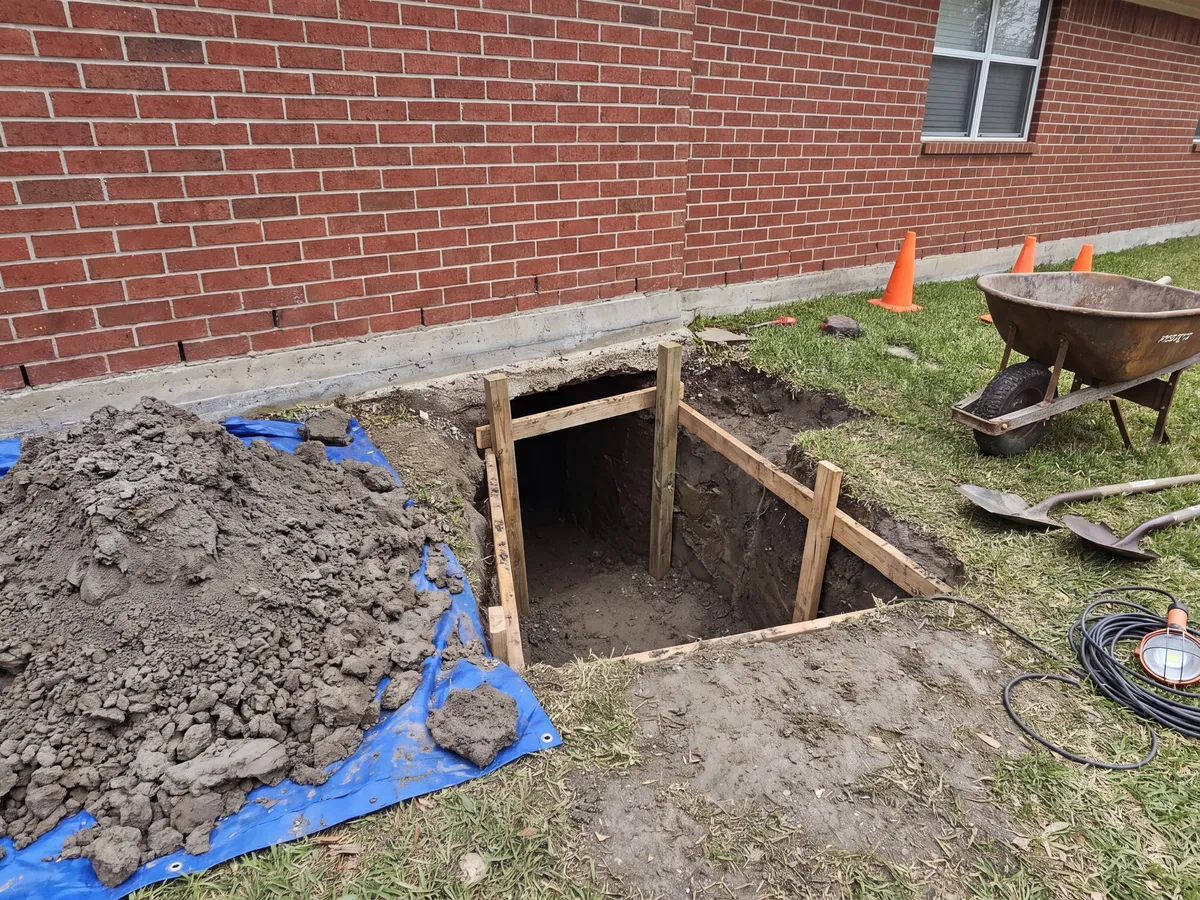
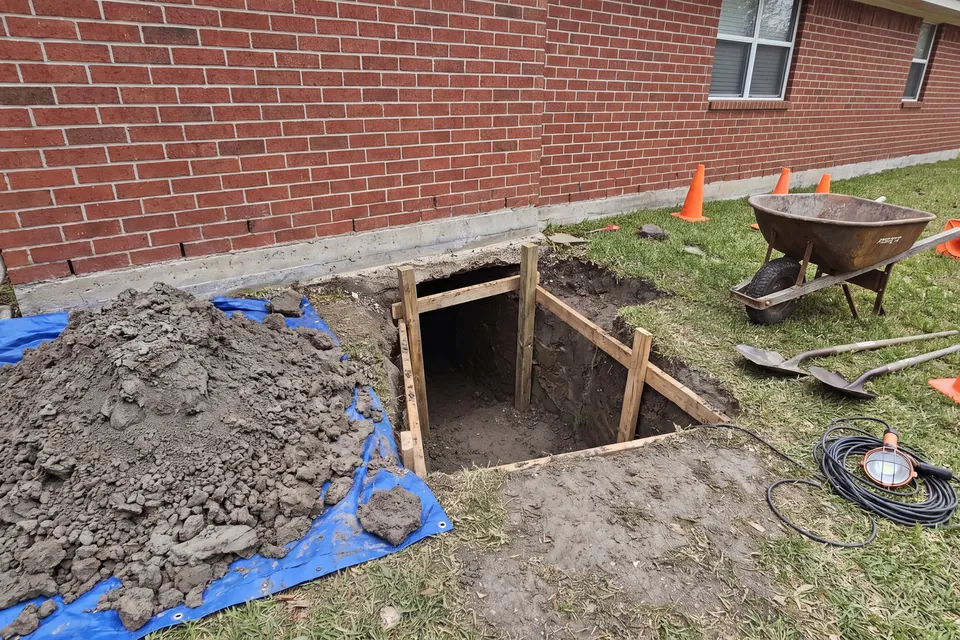
Some repairs live under the middle of your slab: an interior pier, or a failed drain line a plumber has to reach. Rather than break out concrete and finished flooring inside the house, we hand-dig a tunnel in from outside the perimeter beam. Your family stays in the home, and we restore the soil support under the slab before we close it back up.
Houston sits on expansive clay soil that swells when wet and shrinks in drought. That constant movement pushes and drops foundations year after year, and the warning signs often show up inside your home long before the damage looks serious.
Diagonal cracks above doors and windows and stair-step cracks in exterior brick are classic signs of foundation movement. As the clay beneath one part of the home shifts, the structure flexes and the weakest points crack. Cracks that keep widening season after season point to active settling.
When a foundation moves, door and window frames go out of square and start to stick, drag, or refuse to latch. Many homeowners blame humidity, but a frame that never quite works right is often the foundation. Gaps opening at the top corners of door frames are a common tell.
Floors that slope, dip, or feel bouncy underfoot signal that the foundation is no longer level. You might notice a ball rolling across a room or furniture sitting slightly off. If you feel the change as you walk through the house, it is worth a free inspection with elevation readings.
"Amazing work! Explained to me the entire process. Communication was great and also pricing as well. Will definitely hire them for my next project!"

"Outstandinh service and price was much lower than other companies. Lifetime warranty is peace of mind for me and my family."

"Great customer service and very reasonable price."

"⭐⭐⭐⭐⭐ I had an excellent experience with Level Up Foundation Repair & House Leveling. They did an outstanding job with the foundation raising work on my home. From start to finish, they were professi..."

"I recently got my house leveled by LevelUp Foundation. I won’t lie, I was skeptical given that they are a new company with little reviews and not much online presence. But I called them out, they came..."
Regardless of the size or value of the property, I’ve trusted them to handle the work and have always been very happy with the results.
 James EvansTexas Realtor

Every Level Up project includes the same engineered standard. No surprises, no shortcuts.
Elevation readings and an honest assessment of what is moving and why, before any work begins.
A repair designed around your soil, foundation type, and structural load, not a one-size guess.
Steel and concrete pier systems driven to stable load-bearing strata beneath the active clay.
Landscaping, driveways, and finishes protected throughout, with work areas kept clean each day.
Recommendations to keep water away from the foundation so the repair lasts through wet and dry seasons.
A clear line-item proposal with no hidden fees. Nothing starts until you approve the plan.
You review the corrected elevations with our crew before we consider the job complete.
Every repair is backed by a warranty you can pass to the next owner if you sell.
Call us, fill out our online form, or text. Our team responds personally within the same business day to schedule your free foundation inspection.
We visit your home, take elevation readings, and check cracks, doors, floors, and drainage to find the real cause of the movement. You get honest findings explained in plain language.
You receive a detailed, line-item proposal and an engineered repair plan with no hidden fees. Nothing starts until you review every dollar and give the green light.
We complete the work on schedule with engineered pier systems sized for your soil and structure. Every repair is backed by a transferable warranty you can pass to the next owner.
Can't find the answer? Get in touch and we'll respond within 30 minutes.
Tunneling in Houston generally runs $250 to $450 per linear foot, and tunnel length is by far the biggest cost driver. Dense clay digs slower than sandy fill, and obstacles like patios, sidewalks, mature trees, and AC pads can force a longer route to reach the work area. We measure the route and give you a written per-foot scope before we dig, so the number does not move on you mid-project. Keep in mind this covers the access, the pier work, and the restoration. Whatever your licensed plumber charges for the pipe repair is separate and billed by them.
No, and we would rather be plain about that up front. Pipe repair under a slab is licensed plumbing work, so your plumber performs it and handles the permit and inspection. What we do is dig the tunnel, keep it open, shored, and lit while they work, then restore the soil support and close it up. If you do not have a plumber lined up yet, we are glad to coordinate scheduling so the tunnel is not sitting open longer than it needs to be.
Breaking out interior concrete means jackhammers running inside your living space, dust in everything, and tile, wood, or carpet torn out and replaced afterward. It also puts new holes in the slab you are trying to keep strong. Tunneling keeps all of that outside, so your finished floors stay whole and your family can stay in the home. We will be straight with you about the tradeoff: tunneling usually costs more than an interior breakout and it takes longer. Most homeowners still choose it once they price out replacing the flooring.
This is the part that separates a thorough tunnel job from a careless one. Standard soil compaction equipment does not fit inside a three-foot tunnel, so a crew that simply shovels the dirt back leaves voids under your slab. Those voids are unsupported soil, and they are a common cause of new settlement a year or two down the road. We backfill in lifts and then mud-pump a slurry into the tunnel to fill the voids and restore bearing support against the underside of the slab. That method costs more to perform, and it is the only one we use.
Most tunnels take two to five days depending on soil conditions, the length of the run, and how much pier or plumbing work happens underneath. All of the digging happens outside, so there is no jackhammering indoors and no reason to move out. You will have a work area and a spoil pile in the yard for the duration, and we keep it marked off for safety while the tunnel is open. We give you a firm schedule at the estimate and tell you the day we expect to backfill.
Yes. Piers we install through a tunnel carry the same transferable warranty as the rest of our foundation work, so it follows the house to the next owner if you sell. We also stand behind the backfill and mud-pumping, because restoring support under the slab is the entire point of doing the work properly. You get written documentation of the tunnel route, its measured length, and the backfill method for your records and for resale.
We provide foundation repair, house leveling, pier and beam repair, drainage solutions, and free inspections across Houston's neighborhoods and surrounding cities.

Every project includes a free on-site inspection, transparent line-item pricing, and a transferable warranty. No surprises, just a foundation you can trust.